How to Prepare Your Jobsite Routine When Switching from Diesel to Electric
In this article:
- Switching to electric changes your daily site planning much more than your operating technique inside the cab.
- Moving away from diesel minimises fluid checks and fuel logistics, replacing them with basic site power planning and plug-in discipline.
- Daily energy management revolves around two methods: slow AC charging between shifts and midday fast DC charging during scheduled downtime.
Sitting in the cab of an electric excavator feels instantly familiar. The joysticks, attachment speed, breakout forces, and hydraulic responsiveness on the Develon electric range match the proven diesel models you already run. Operators do not need to relearn how to dig or adjust their operating style to stay productive.
Where the real transformation happens is outside the cab. Switching from diesel to battery power shifts the logistical rhythm of the jobsite. Instead of managing liquid fuel deliveries, fuel canisters, and morning warm-ups, energy planning becomes a natural part of the schedule. It isn't about adding complex chores — it is a straightforward swap of diesel tasks for clean energy management.
1.
What Drops Away vs. What Takes Its Place
Switching from diesel to electric removes traditional morning rituals and winter preparation, replacing liquid fuel logistics with basic site power management.
What Drops Away (Diesel Routines):
- Engine oil checks: No oil levels to monitor, no oil changes, and no fluid disposal.
- Filter & aftertreatment service: No fuel filters, air pre-cleaners, AdBlue® top-ups, or DPF regeneration cycles.
- Fuel logistics & winter prep: No diesel bowsers, fuel deliveries, fuel canisters, or anti-gel additives in freezing weather.
- Morning idle warm-ups: Reduced warm-up time before operating hydraulics.
What Replaces It (Electric Discipline):
- End-of-shift plug-in: Assigning clear responsibility for plugging the machine in at night and verifying charge initiation.
- Site power coordination: Confirming power availability on-site before delivery, covering both total jobsite power draw and socket compatibility (230 V vs. 3-phase 400 V).
- Standard mechanical checks: Daily inspections focus purely on wear items — tracks, pins, bucket teeth, and hydraulic lines.
Rather than eliminating site chores, electric operation trades liquid fuel logistics for daily charging discipline. If someone forgets to plug the machine in at night, the next shift stops before it starts.
2.
How Do You Plan Charging: AC vs. DC?
Charging fits around a normal working shift once you separate it into two distinct technical categories:
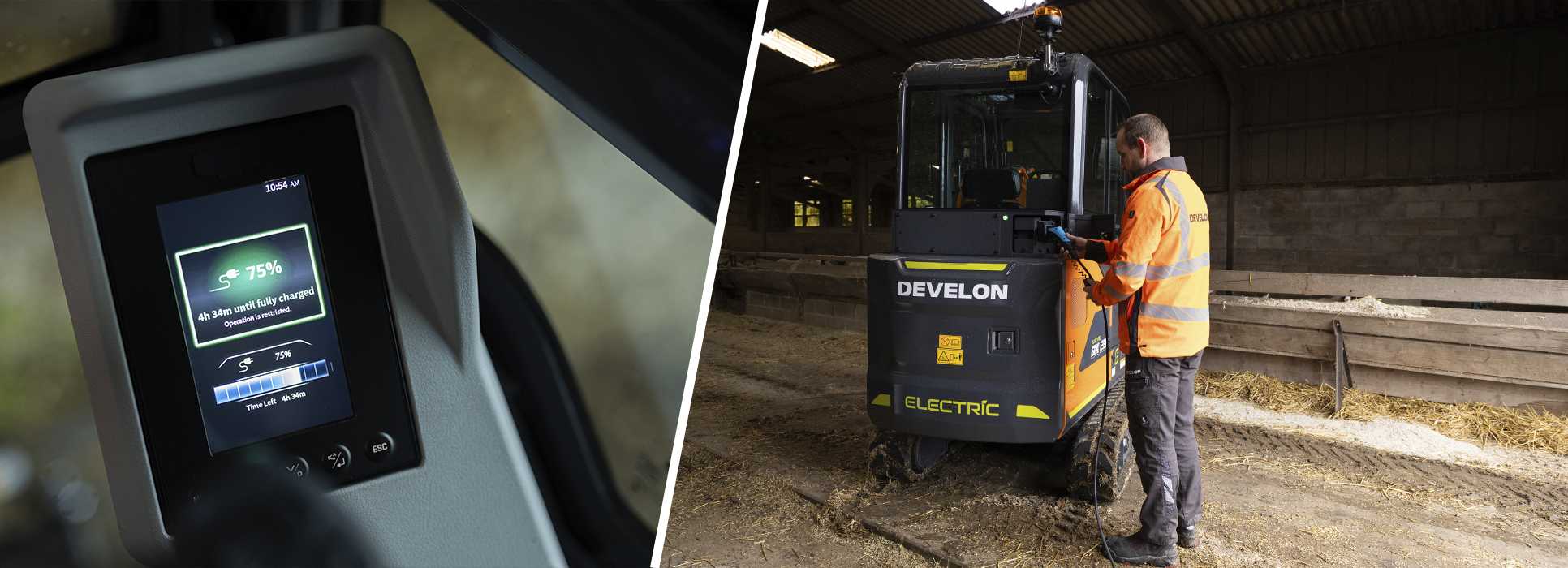
- Overnight Slow Charging (AC): Uses alternating current directly from the grid or yard supply through the machine's onboard charger. Depending on machine size, this may be your primary between-shift routine — plug in at the end of the day, and the machine recovers a full charge overnight while parked.
- Midday Fast Charging (DC): Uses a dedicated off-board charger instead of the machine's onboard charger to deliver high-power direct current to the battery pack. This option tops up the battery’s charge during lunch breaks or during operator shift changes on heavy, continuous digging projects.
Develon Electric Range Charging Specifications
| Model | Category | Battery Pack | AC Charging | Fast DC Charging | Required Site Connection (AC) |
|---|---|---|---|---|---|
| DX20ZE-7 | Mini Excavator | 20.4 kWh | 3 kW (~8 h) |
15 kW (~1.1 h) |
Standard 230 V socket |
| DX23E-7 | Mini Excavator | 32 kWh / 40 kWh | 3 or 6 kW (~6–13 h) |
15 kW (~1.5–2.5 h) |
Standard 230 V socket |
| DX85RE-7 | Mini Excavator | 235 kWh | 22 kW (~10 h) |
105 kW (~2 h) |
3-Phase Industrial (32 A or 63 A) |
| DX100WE-7 | Wheeled Excavator | 235 kWh | 22 kW (~10 h) |
105 kW (~2 h) |
3-Phase Industrial (32 A or 63 A) |
| DX160WE-7K | Wheeled Excavator | 380 kWh | 40 kW (~6 h) |
180 kW (~1.5 h) |
3-Phase Industrial (32 A or 63 A) |
| DX230LCE-7 | Crawler Excavator | 435 kWh | 40 kW (~8 h) |
180 kW (~2 h) |
3-Phase Industrial (32 A or 63 A) |
| DX250LCE-7 | Crawler Excavator | 570 kWh | 40 kW (~9 h) |
180 kW (~2.5 h) |
3-Phase Industrial (32 A or 63 A) |
(Note: Charging times are approximate and vary based on grid stability, ambient temperatures, and thermal management conditions.)
3.
Where Will the Machine Charge?
Selecting the right charging location is often more critical than the charger itself. Field logistics generally break down into three primary operational scenarios:
- Returns to the Yard: The simplest option. The machine is charged overnight at a fixed depot where electrical supply, site security, and operational responsibility are straightforward to manage.
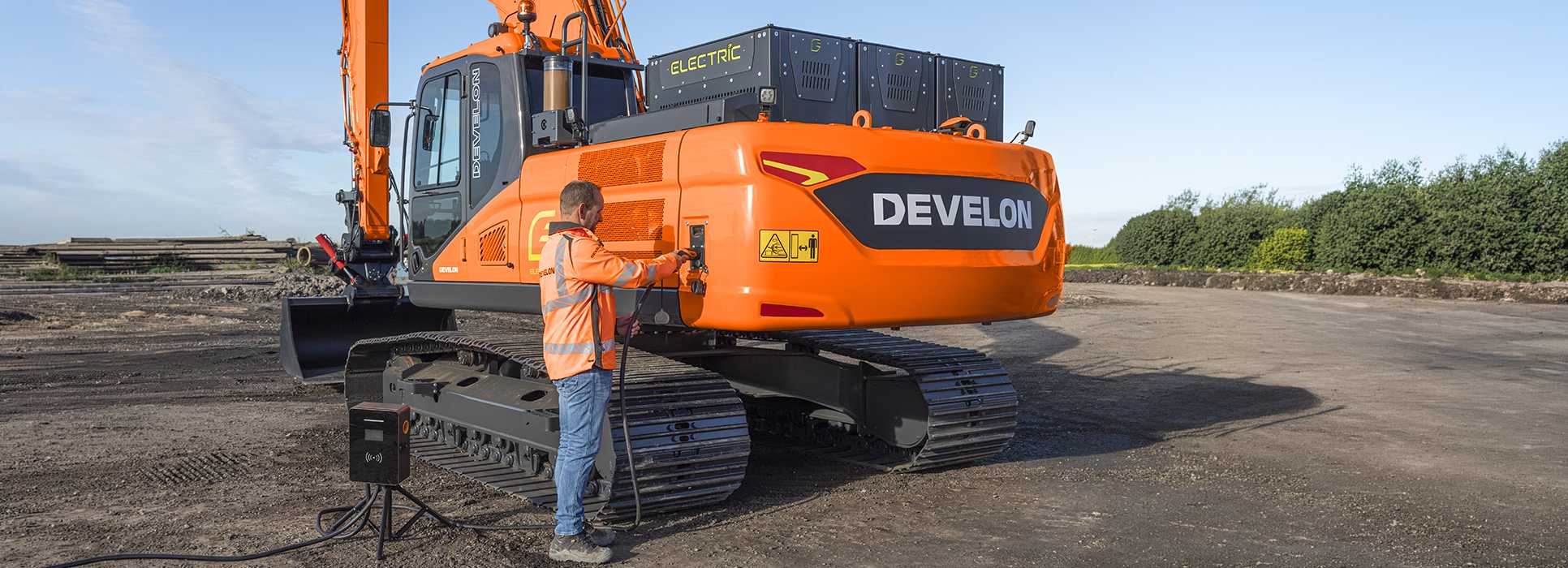
- Stays on Site: Requires verifying site electrical infrastructure before delivery. While compact models like the DX23E-7 can charge overnight on a standard 230 V line, larger excavators demand a dedicated 3-phase industrial connection for AC charging. Never assume a powered site has the correct connection available.
- No Suitable Grid Connection Available: Off-grid operation relies on mobile Battery Energy Storage Systems (BESS) and temporary fast-charging units. These mobile power hubs bridge the infrastructure gap on greenfield sites, provided their rental/purchase and transport logistics are integrated into the initial project budget alongside machine operating costs.
Verdict: Site Power as Critical Logistics
Charging does not happen in isolation. Site cabins, lighting, and power tools share the same grid connection — requiring automated load management or staggered charging schedules to avoid tripping the site breaker.
Success with electric machines boils down to simple pre-delivery readiness: confirm physical socket compatibility (230 V vs. 3-phase 400 V) before the transport flatbed leaves, establish commercial metering terms up front, and assign named individual ownership for the end-of-shift plug-in routine.
4.
Will One Charge Cover Your Working Day?
There is no single answer. Runtime depends on machine size, type of work, working intensity, attachments, shift length, and operating conditions.
A machine doing intermittent utility work uses energy completely differently from one digging continuously for hours. So, the right question is not only “How long does the battery last?”—it is “Does that runtime fit the work I actually do?” That should be checked before deciding where an electric machine fits in your fleet.
To evaluate your specific site conditions, work intensity, and expected battery depletion:
- Read our article on whether an electric excavator is right for your jobsite to see how to match machine power and shift lengths to your needs.
- Use the interactive Develon Charging Calculator to calculate your estimated daily runtime and determine whether midday DC charging will be required for your operational profile.

5.
What Does the Site Need Before Delivery?
Before your first electric machine arrives on site, run through this practical setup checklist:
- Verify Connection Strength: Confirm if the site supply matches the machine class (standard 230 V line for compact models vs. 3-phase 400 V industrial connection for heavy excavators, available current).
- Budget Total Site Draw: Stagger charging schedules or install automated load management to ensure that shared power draw from cabins, tools, and lighting doesn't trip the main site breaker.
- Order Grid Infrastructure Early: Request temporary site grid connections or power upgrades weeks in advance during initial project planning, rather than during mobilization week.
- Assign Plug-In Ownership: Name a specific operator or site manager responsible for plugging in the charger at night and verifying that charging has initiated.
- Plan Layout & Security: Position weatherproof charging points clear of excavation and haul traffic, route heavy power cables away from track paths to prevent cable damage, and secure external DC chargers overnight.
- Confirm Off-Grid Fallbacks: If grid power is not yet available on site, budget and arrange mobile Battery Energy Storage Systems (BESS) and temporary mobile chargers well before delivery.